Clay Colored Robin

When I saw the words “clay-colored” I was expecting a very plain bird. And mostly, it is rather plain looking by all accounts. But even with a plain coat, I was entranced by that copper-colored eye. And the more I looked, the more color I found: green and orange flashes in the bill.

Color is dangerous for me, because I don’t really understand it. My crap art school education at UC Berkeley taught me nothing of color theory, and I’ve worn only black for nearly two of my three decades. Color is scary. But the more I look for it, the more I find it in these wonderful little birds.

Groove Billed Ani

The groove billed ani is a member of the cuckoo family. Cuckoos are distinct because they have two toes that point forward and two that point back (unlike the more common bird foot, three forward and one back.)

I didn’t know it was a type of cuckoo when I drew it. But I thought that big hooked bill made it look kind of menacing, like a raven or other scavenger. So I picked this background to go with that mood. Ominous.

Common Shelduck

Neat bright red bills on the shelduck. I had fun with this one, using my watercolor pencils. I don’t usually use the watercolor-ness of them to the full advantage, but it seems to work really well when doing both the shiny beak texture and a mass of evenly smooth feathers.

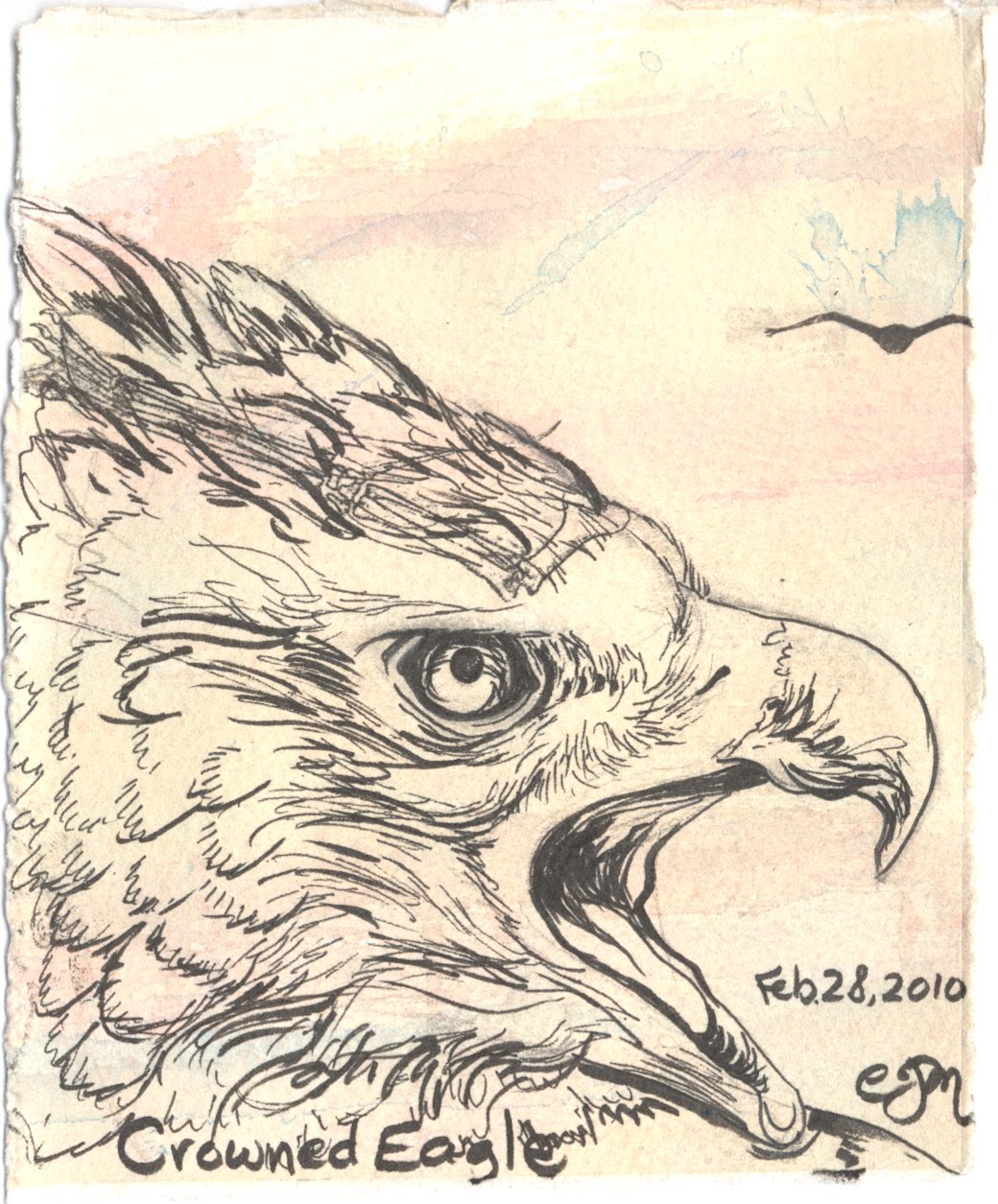
Crowned Eagle

Kaw!

I didn’t spend as much time on the details with this one. I was more interested in capturing his energy and the strong emotions I read in his face. I could just be anthropomorphizing. But I like how urgently he appears to be yelling.

White-tailed Tropicbird

I like the tails on these birds. They have a few long feathers that extend down the middle of the tail. For a black and white bird, it’s quite a nice touch of flair.

I once made the point of mentioning that I am lazy at backgrounds. Here is a perfect example. In the photo, this bird has his butt nestled against a pile of rocks. So it makes sense that both his tail and his shadow climb the rock face. However, I hate drawing rocks. So I just left them out. And both tail and shadow hover in a bizarre white world. Oh well. At least now you know why the shadow does that weird thing.

Blue-crowned Motmot

This bird has a beautifully colored head. But I should really do a full figure drawing of this one. Check out its neat tail on wikipedia.

I recently visited the library and checked out the gigantic book Birds of the World by Lee Beletsky. Most of the huge encyclopedic books with full color pictures are secured in the reference section, so I can’t take them home and draw birds from them. Sad. But Birds of the World was amazingly available. It’s full of full color illustrations. While I’m not about to draw a copy of another artist’s drawing, I am getting lots of great ideas for birds to look up on-line.

And I have renewed respect for natural science illustrators. Who knew that there were so many different types of albatrosses? And each one has only the tiniest difference. It’s amazing the details these artists and scientists can observe and classify.